Mexico’s Most Famous Resort Brand Just Launched a Cruise Ship. Here’s What Makes It Different.
Grupo Vidanta has spent five decades building some of North America’s most celebrated luxury resort destinations. Now, the Mexican hospitality giant has set its sights on the open ocean — and the result is turning heads across the cruise world.
The company’s debut vessel, the Elegant, began welcoming guests in the Mediterranean this spring. With room for just 216 passengers, the ship sits in a category all its own — too intimate to be a traditional cruise ship, too ambitious to be called a yacht. For Vidanta, that ambiguity is entirely intentional.
Why They Rejected Every Shipyard That Came Calling
Before the Elegant ever took shape, Vidanta spent considerable time exploring the conventional route. Shipyard after shipyard was approached. Each conversation ended the same way.
The answer was always some variation of the same offer — a copy of something already being built for another client, with delivery pushed seven or eight years into the future. For a company built on originality, it was a non-starter.
Executive vice president Ivan Chavez described the moment Vidanta’s thinking shifted. Rather than ordering something new, the company acquired an existing vessel — the former Voyager, a 1990-built ship that had been carrying over 500 passengers before the collapse of its previous owner, the All Leisure Group, in 2017.
The development team’s instinct when they first stepped aboard wasn’t to see a ship at all. They saw a building plot.
“When you have a great architect come in, the number one constraint is the size of your land — what can you do with that?” Chavez said, explaining how Vidanta applied its real estate mindset to the project. It was the same creative logic that produced their Cirque du Soleil dining partnership, a Jack Nicklaus-designed compact golf course, and an upcoming theme park built around eliminating wait times entirely.
Gutted, Rebuilt, and Reimagined From the Hull Up
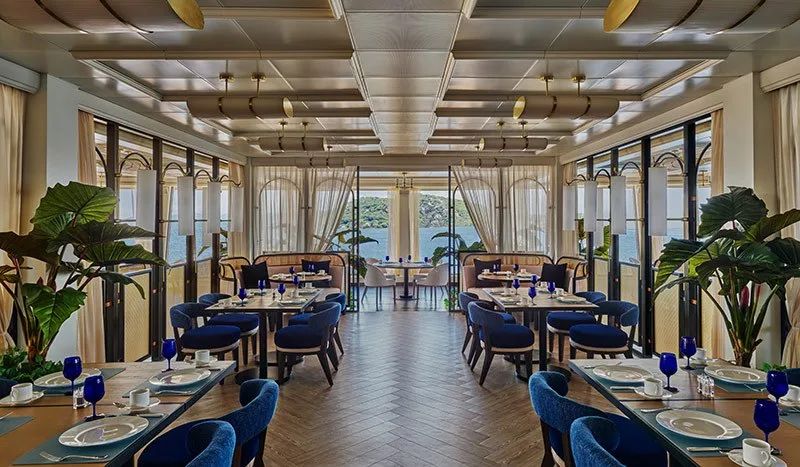
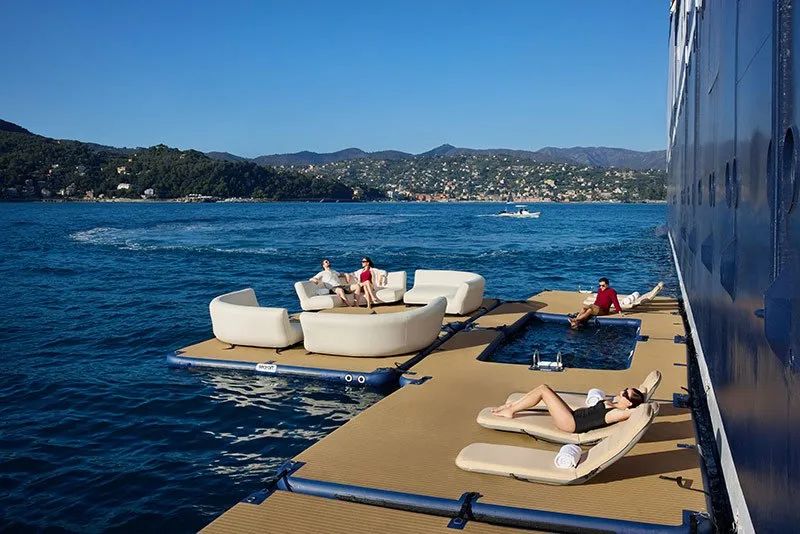
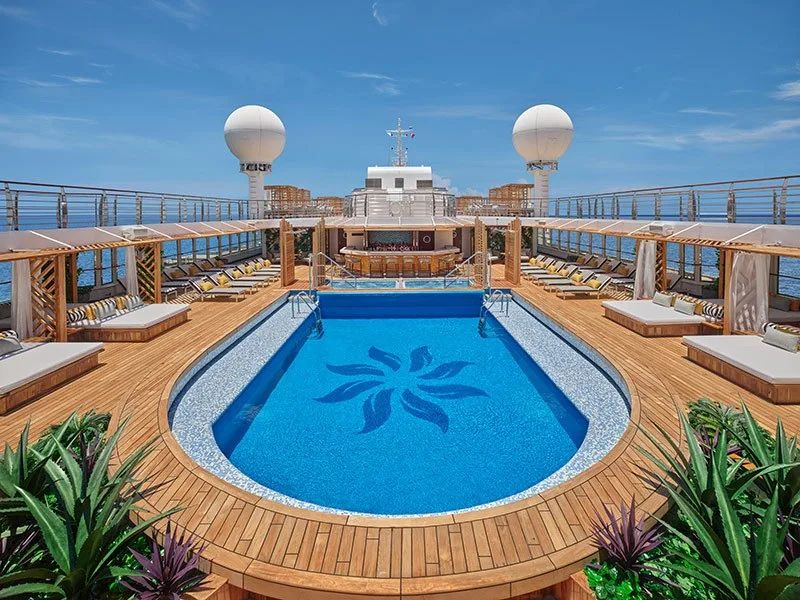
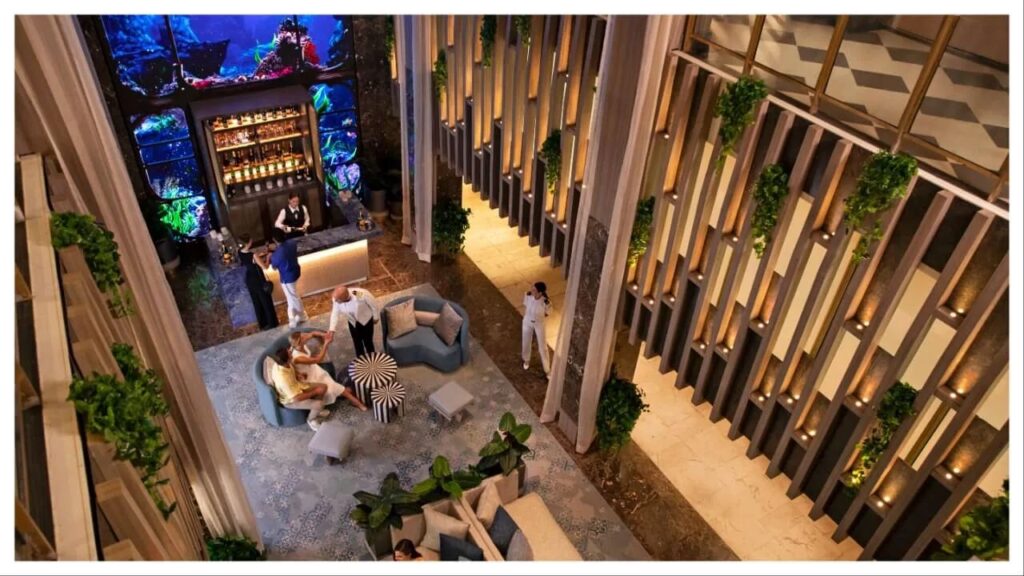
What happened to the Voyager over the years that followed its acquisition was nothing short of a complete reinvention. A new restaurant structure was added to the stern. Interior cabins were cleared out to make way for generous open-air deck areas. A proper theater was constructed where only a basic lounge had existed before. Entirely new restaurants, bars, a casino, spa, fitness facilities, a marina lounge, and a deployable marina platform were all brought on board. According to Chavez, not a single guest-facing element of the original ship remains unchanged.
The cabin situation required its own rethink. When Vidanta ran test sailings off the coast of Mexico with guests from their land resorts — many of whom had never set foot on a cruise ship before — the feedback was immediate. The staterooms, despite being larger than the cruise industry standard, felt small to people accustomed to Vidanta’s famously oversized resort accommodations.
The solution was characteristically Vidanta. Rather than ask guests to adjust their expectations, the company simply knocked down walls. Suites were formed by combining multiple original cabins — sometimes two, sometimes three, occasionally four — with Swedish firm Tillberg Design and the New York-based Rockwell Group, a longtime Vidanta collaborator, handling the interiors. When the dust settled, the ship’s capacity had been cut from more than 500 down to 216.
No All-Inclusive. That’s the Point.
Pricing philosophy was another area where Vidanta deliberately broke from cruise industry convention. The Elegant operates without an all-inclusive structure — a conscious echo of how the company positions its resort properties on land.
Chavez was direct about the reasoning. In Vidanta’s view, bundling everything into one flat price actually works against quality. When guests are paying individually for each meal or service, the kitchen and the staff have skin in the game. Every transaction becomes an opportunity to either earn loyalty or lose it. That accountability, in Vidanta’s model, is what drives standards upward.
It’s a stance that cuts against the grain of where much of the broader cruise market is heading — but then again, swimming against the current has always been part of the Vidanta identity.
Evenings in Europe, on Their Own Schedule
Sailing with fewer than 220 guests and a pair of onboard tenders opens doors that remain firmly closed to larger vessels. The Elegant can drop anchor in Saint-Tropez, ease into Monte Carlo, and call at Cannes — ports where mega-ships simply cannot follow.
But Vidanta’s approach to the itinerary went beyond port selection. The team felt strongly that designing a European sailing around daytime arrivals and early departures was leaving the best part of the experience on the table. Every voyage now features late-night departures — frequently around midnight — with certain destinations extended to multi-night stays.
The goal was to let guests experience places like the French Riviera the way locals actually live in them: after dark, when the light is golden and the pace slows down. Chavez noted that Vidanta was able to lock in between 85 and 90 percent of its preferred port access — a strong result for a newcomer navigating unfamiliar maritime logistics.
Built for North Americans, Designed to Grow
The guest profile for the Elegant‘s opening season reflects Vidanta’s existing resort customer base — approximately three quarters of passengers are coming from the United States and Canada, with the remainder from Mexico. Before opening to the public, the ship completed two full months of internal test sailings, with Vidanta’s own senior resort staff working shoulder-to-shoulder with veteran cruise professionals to develop a service culture that bridges both worlds.
The ship leans adult, though a small selection of cabins are released for families during certain summer departures. When the Mediterranean season wraps, the Elegant will spend the European winter moored on a river in northern France, available for private charters — with notable demand already coming from the film industry and wealthy families interested in booking the entire vessel exclusively.
As for what comes next, Chavez was candid that one ship was never the destination.
“This is the size we wanted to start with — to understand and learn the industry,” he said. “We want to grow to more ships.”
In an industry where growth increasingly means bigger, louder, and more crowded, Vidanta is quietly betting that the future might look something like the opposite.