Perfect Day Mexico Has Been Officially Shut Down by the Mexican Government
It was supposed to be the boldest private cruise destination ever built. A 230-acre waterpark paradise on Mexico’s Caribbean coast, capable of welcoming tens of thousands of visitors a day. Royal Caribbean had already spent hundreds of millions of dollars making it happen.
On May 19, 2026, Mexico said no. And that was that.
The Announcement That Changed Everything
Standing at a podium in Mexico City, Environment Minister Alicia Bárcena delivered the verdict without equivocation. The Perfect Day Mexico project, she told reporters, would not receive government approval. The statement was short, direct, and final.
Mexican President Claudia Sheinbaum had previewed the decision just 24 hours earlier, making her administration’s priorities clear during her morning press briefing. The coastal ecosystem surrounding Mahahual — the small fishing village where the project was planned — was not something her government was prepared to compromise.
“We must not do anything that affects that area, which has a very important ecological balance, and is particularly important for the reefs,” Sheinbaum said.
Royal Caribbean confirmed the news and chose its words carefully. The company expressed regret at the outcome, said it respected Mexico’s environmental authorities, and struck a tone that suggested it had seen this coming. According to Minister Bárcena, the cruise line had already been quietly distancing itself from the project before the formal announcement landed — reading the room well ahead of the press conference.
What Was Being Built and Why It Was Stopped
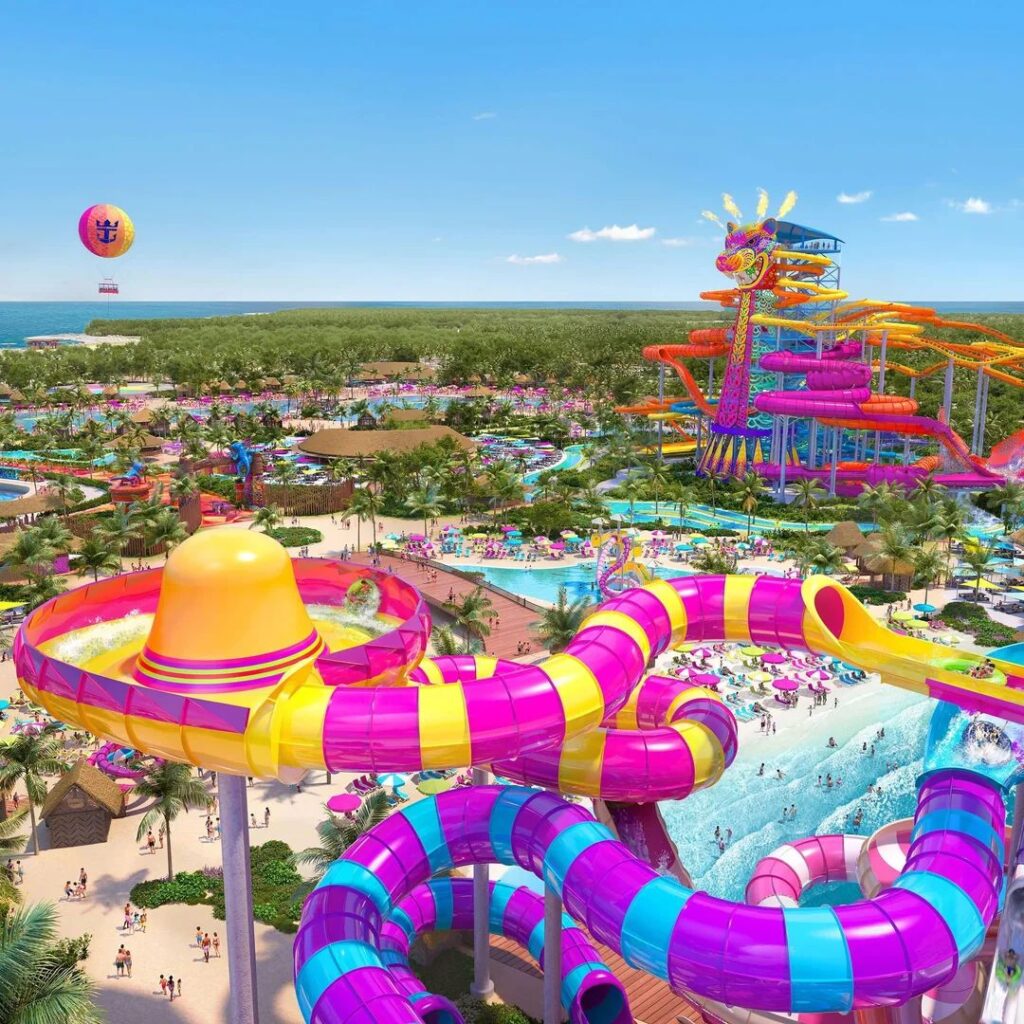
Perfect Day Mexico was conceived as a direct counterpart to Royal Caribbean’s wildly successful Perfect Day at CocoCay in the Bahamas — but supercharged. The planned destination covered roughly 230 acres of coastal land near Mahahual, a village of fewer than 3,000 people on Mexico’s southern Caribbean coast. Advertised in Royal Caribbean’s own materials as the “biggest, baddest, boldest destination” the cruise line had ever attempted, it would have featured beach clubs, a sprawling pool complex, bars, and more than 30 waterslides. At peak capacity, the site was designed to absorb up to 21,000 visitors in a single day.
The problem was what surrounded it.
Mahahual sits on the edge of the Mesoamerican Barrier Reef — the largest reef system in the entire Western Hemisphere. Its waters support an extraordinary ecosystem of coral, fish, and marine life. Sea turtles nest along its beaches. The coastal mangrove forests provide critical protection against erosion and serve as natural water filtration systems for the broader region. Inland, the jungle is jaguar territory. The entire area exists in a state of ecological balance that took millennia to establish and can be undone in a fraction of that time.
Environmental groups, led by Greenpeace, had been warning for months that the region was approaching a point of no return. A legal challenge filed by the environmental rights organization Right to a Healthy Environment had already succeeded in halting construction through an injunction issued by a Quintana Roo district court in January 2026. That pause gave the government time to assess the situation — and what they found did not support moving forward.
The People Spoke — In Enormous Numbers
What made this story different from many environmental versus development battles is the sheer scale of public opposition. A petition launched online in July 2025 calling for the project to be blocked grew to more than 4.6 million signatures by the time the cancellation was announced. To put that number in context: Mahahual itself has around 3,000 residents. The concern spread far beyond the immediate community and far beyond Mexico’s borders.
Organizers of the campaign argued that building a 90-hectare development on protected mangroves would fundamentally alter the coastline, deny local residents access to beaches they had fished and swum on for generations, and push the reef ecosystem past a threshold from which it would struggle to recover.
The combination of legal action, presidential messaging, and one of the largest environmental petitions in recent Mexican history proved insurmountable.
The Financial Damage
Royal Caribbean had committed to this project with a level of financial seriousness that makes the cancellation genuinely painful. The cruise line had already transferred $292 million to acquire the Costa Maya port facility and the surrounding land. A further $529 million had been designated for the construction phase — money that was never spent but was effectively locked into a plan that no longer exists.
The strategic loss compounds the financial one. Perfect Day Mexico had been positioned as a centerpiece of Royal Caribbean’s deployment strategy for the second half of the decade. Itineraries had been shaped around its anticipated arrival. The private destination model — proven in the Bahamas — was supposed to deliver its next chapter in Mexico. That chapter will not be written, at least not in this form.
Royal Caribbean said it remains committed to its investment in Mexico and intends to work with local stakeholders in the coming weeks on alternative paths forward — potentially including environmental infrastructure, local job creation, and community development programs. The cruise line had already funded road improvements in and around the site as part of its earlier commitment to the area, and those efforts stand as a small tangible legacy of a much larger vision.
Life Goes On in Costa Maya
For the millions of cruise passengers who visit Costa Maya each year, operations continue as normal. The port itself — now Royal Caribbean-owned — welcomed 2.8 million visitors in 2025 and remains one of the busiest cruise destinations on Mexico’s Caribbean coast. Ships will keep calling there. Passengers will keep exploring Mahahual’s village streets, diving the reef, and photographing the coastline.
They just won’t be doing it from a private island with 30 waterslides.
For the fishing village that fought back against a $600 million development with a petition and a court filing, that is not a small thing.
The reef is still standing. For now, the sea wins. 🌊