Mexico Says It May Let Royal Caribbean Relocate Perfect Day Mexico
Two weeks ago, Mexico said no to Perfect Day Mexico. Now, Mexico is saying — maybe, somewhere else.
In a development that has caught the cruise world off guard, Mexican President Claudia Sheinbaum confirmed on May 27, 2026, that federal officials are in active discussions with Royal Caribbean about the possibility of relocating the rejected private destination project to a different site within the country.
It is a significant shift in tone from a government that, just days earlier, had appeared to draw a firm and final line under the Mahahual development.
What Mexico Is Actually Saying
The distinction between what Mexico has confirmed and what has been assumed matters enormously here. What President Sheinbaum said is that talks are underway to explore whether another location could accommodate the concept without triggering the same environmental concerns that doomed the original proposal.
What has not been said — and what does not yet exist — is a named alternative site, an approved permit path, a revised timeline, or any confirmation that a relocated Perfect Day Mexico is happening.
“We are in talks with the company to see if there are any locations where the project could be developed without these environmental impacts,” Sheinbaum said, “and we will first analyze whether it truly has environmental viability.”
That is a conditional offer, not a green light. Any new location would need to pass the same kind of environmental review that the Mahahual site failed. Mexico’s Environment Ministry, SEMARNAT, would need to evaluate ecological impact, reef proximity, mangrove exposure, and community effect before any new proposal could advance. That process takes time — and given how the Mahahual review ultimately played out, there is no guarantee a replacement site clears the bar.
Why This Complicates Everything
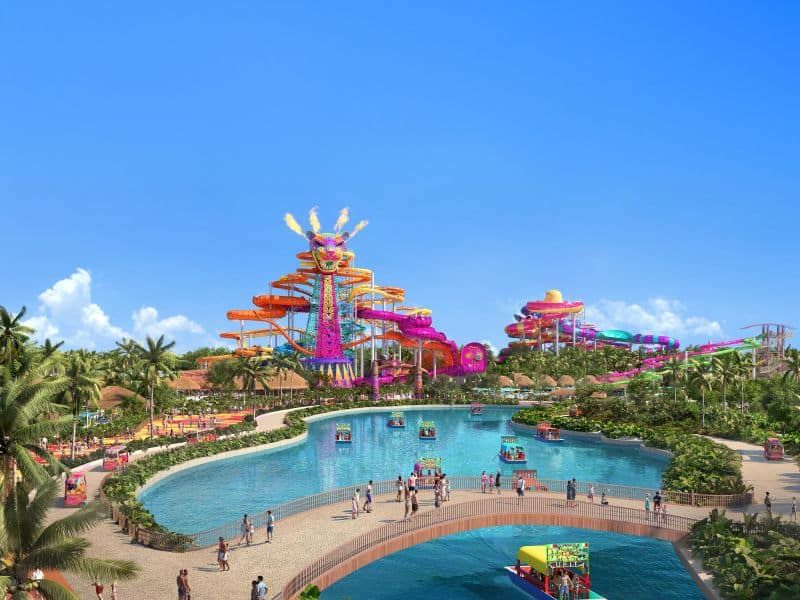
The original Perfect Day Mexico project had a specific logic that was deeply connected to its location. Mahahual sits directly adjacent to the Costa Maya cruise port — a facility that Royal Caribbean had already purchased for $292 million specifically because of its proximity to the planned resort. Ships could dock at Costa Maya and guests could walk or transfer to the destination.
A relocation breaks that equation entirely. A new site would need its own cruise access infrastructure, its own road and utility connections, its own staffing and vendor ecosystem, and its own guest flow planning capable of handling thousands of passengers simultaneously. None of that can be improvised quickly.
The fall 2027 opening that Royal Caribbean had publicly marketed is almost certainly no longer achievable regardless of what happens next. A resort of this scale cannot be planned, permitted, designed, and built in little more than a year — particularly when the starting point is still an exploratory conversation about which country is even willing to host it.
What Is Happening to Mahahual in the Meantime
While relocation talks are underway, Mexico appears to be moving in a separate direction with the original site — and that direction makes a return to Mahahual increasingly unlikely even if the relocation discussions were to stall.
SEMARNAT and other Mexican government agencies are reportedly preparing a formal decree to orient Mahahual toward ecotourism, protecting the area from large-scale development and establishing conditions under which only lower-impact tourism activity would be permitted. The state government of Quintana Roo has also committed significant infrastructure funding to improve roads, plazas, and waterfront facilities for the existing community of roughly 2,600 residents.
If that decree is formally adopted, the door on large-scale cruise destination development in Mahahual closes significantly — possibly permanently. President Sheinbaum acknowledged this possibility directly, noting that officials are evaluating whether to grant the area additional environmental protection status, which would limit future development to ecotourism under strict conditions.
Where This Leaves Royal Caribbean
The cruise line has not publicly commented on the relocation discussions. When the original rejection was confirmed, Royal Caribbean told media that it respected SEMARNAT’s decision and remained optimistic about investing in Mexico responsibly. That statement has not been updated.
What Royal Caribbean is dealing with is a private destination strategy problem with no easy solution. The entire point of Perfect Day Mexico was to create a Western Caribbean equivalent to Perfect Day at CocoCay — a destination so compelling that it becomes a meaningful factor in passengers’ decision to book a Caribbean itinerary. CocoCay transformed Royal Caribbean’s short Caribbean cruise business. Perfect Day Mexico was supposed to do the same for the Gulf Coast and Texas homeport markets.
Without it, the Western Caribbean itinerary lineup relies heavily on ports like Cozumel, Roatan, and Grand Cayman — established destinations that Royal Caribbean shares with every other cruise line rather than controls entirely.
The business case for finding a workable alternative has not diminished. What has changed is how much harder that alternative is going to be to find, approve, and build — and how much longer it is going to take.
What Comes Next
The next meaningful milestone in this story is not another statement of optimism from either side. It is a named replacement site. After that, watchers should look for an environmental filing, a government viability determination, and eventually, itinerary listings that show Perfect Day Mexico as an actual bookable destination on real sailings.
Until all of those things exist, the practical advice for anyone planning a Western Caribbean cruise is straightforward — book for the ship, the dates, the price, and the confirmed ports. Treat Costa Maya as Costa Maya. Cruise calls there continue normally regardless of what happens with the private destination project.
The conversation between Royal Caribbean and Mexico is real. The destination, for now, is not.