Carnival Cruise Ship Rescues Nine People From Disabled Boat Drifting off Florida Coast
Most passengers boarding a cruise ship expect the biggest excitement on embarkation day to involve a sailaway party and the first trip to the buffet. The guests who boarded Carnival Mardi Gras on May 16 got something considerably more dramatic — a real-life maritime rescue operation unfolding right outside their cabin windows.
Just hours after departing Port Canaveral on a seven-night Eastern Caribbean sailing, one of the largest cruise ships in the world changed course to come to the aid of nine people stranded in a disabled boat drifting off Florida’s central east coast. Every single one of them made it safely aboard.
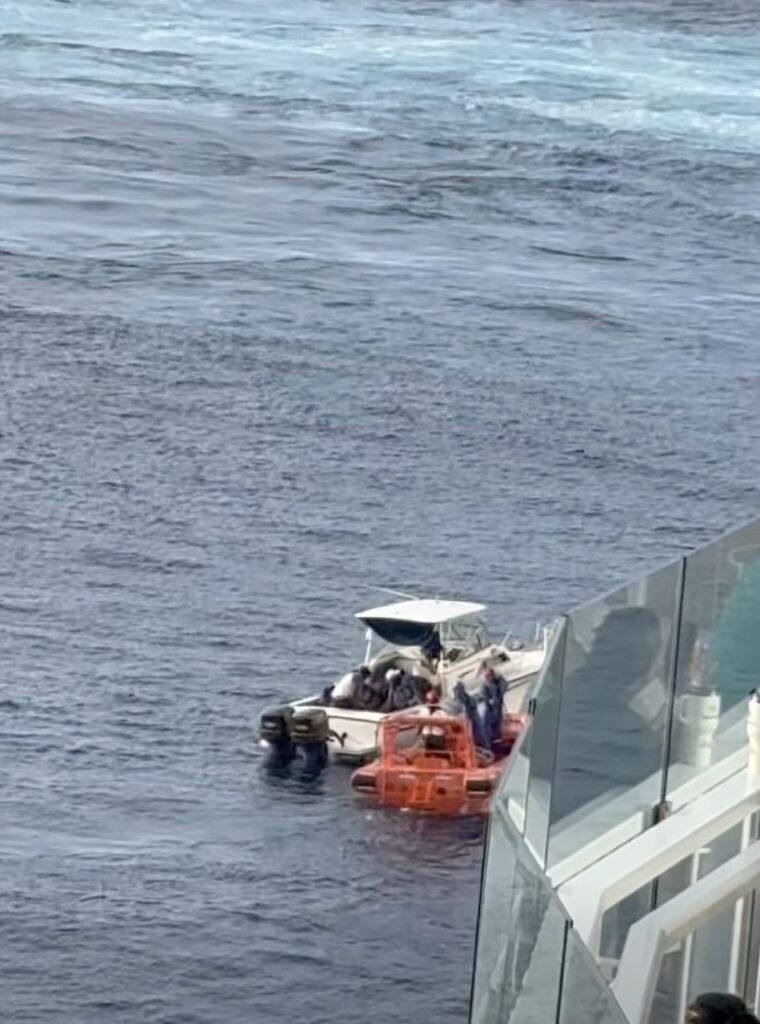
Spotted in the Water Near Sebastian Inlet
The rescue took place in the early hours of the sailing, not long after Mardi Gras had cleared Port Canaveral and was heading out toward the open Atlantic. Crew members on watch spotted something that immediately demanded attention — a small disabled vessel near Sebastian Inlet, located along Florida’s central east coast, with the people aboard doing everything they could to get noticed.
Those on the stricken craft were waving a distress flag and using their arms to signal frantically at the massive cruise ship passing nearby. The crew wasted no time. A rescue team was dispatched in one of the ship’s smaller vessels to reach the disabled craft and assess the situation, while the US Coast Guard was notified simultaneously.
All nine adults were brought safely aboard Mardi Gras, where they received food, water, and whatever medical attention was needed. Passengers watching from the decks above reportedly broke into applause as the operation concluded successfully.
In a statement confirming the rescue, a Carnival spokesperson described the sequence of events: the crew had spotted the vessel flying a distress flag, immediately notified the Coast Guard, and safely brought everyone on board.
One Night Aboard the World’s Biggest Cruise Ship
The nine rescued individuals spent one night aboard Mardi Gras — an 180,800-gross-ton Excel-class ship capable of carrying over 5,000 guests — before being disembarked the following morning when the ship arrived in Nassau, Bahamas. There, they were transferred into the care of Bahamian authorities, who will carry out screenings to determine whether any further medical attention is needed and what next steps are appropriate regarding their status.
Carnival has not released the identities or nationalities of the rescued individuals, nor has it confirmed what caused the boat to become disabled, how long the group had been drifting before being spotted, or where they were originally headed. The disabled craft itself was left in the water following the rescue and was subsequently retrieved by the US Coast Guard.
Crucially, the rescue had zero impact on the sailing for the thousands of paying passengers aboard. No itinerary changes were made and no port calls were affected. Mardi Gras is continuing its scheduled Eastern Caribbean route, with stops at Amber Cove in the Dominican Republic, Grand Turk in the Turks and Caicos, and Carnival’s own Celebration Key in the Bahamas, before returning to Port Canaveral on May 23.
Why Cruise Ships Are Required to Help
What passengers watching from the deck were witnessing was not just an act of generosity — it was also a legal obligation. Under SOLAS, the international Safety of Life at Sea convention that governs maritime operations globally, any ship captain who receives information that people are in distress at sea is required to provide assistance as quickly as possible. The rule exists because survival odds at sea deteriorate rapidly once a vessel is disabled, and a passing ship may represent the only realistic chance of survival for those in the water or adrift.
Carnival has been vocal about its commitment to this principle. Brand Ambassador John Heald has stated publicly on multiple occasions that Carnival ships will always stop for people in peril on the ocean — no exceptions, no hesitation.
When rescued individuals are brought aboard, they are not simply given free access to the ship. Standard protocol involves keeping them in designated areas under the supervision of the security team, separate from the general guest population, until they can be handed over to appropriate authorities at the next port of call.
Part of a Pattern of Rescues This Year
Saturday’s operation is the latest in a string of at-sea rescues involving Carnival ships in 2026 alone. Earlier this year, Carnival Legend came to the aid of a man and his cat who were stranded on a disabled sailboat while the ship was en route to Cozumel. Before that, Carnival Celebration rescued five people from a sinking makeshift vessel during a Western Caribbean sailing in February.
Three rescues across the fleet in a matter of months is a reminder that cruise ships — often discussed primarily as floating entertainment complexes — remain working maritime vessels operating in waters where emergencies happen and where their size, speed, and trained crews make them uniquely capable of making a difference.
For the nine people drifting near Sebastian Inlet on Saturday afternoon, the sight of Carnival Mardi Gras changing course toward them was the moment everything changed.